








Andrea Johns discusses building community driven Indigenous programming at Jackman Law
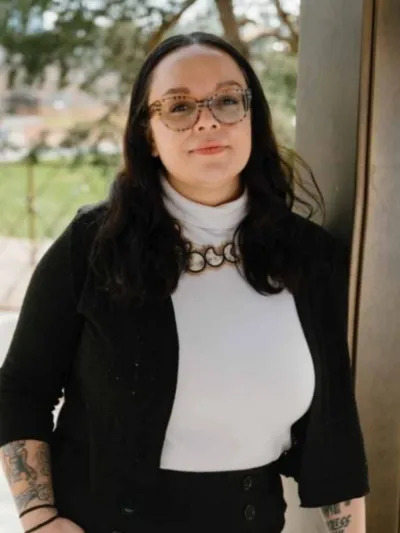
On Wednesday, February 11, Ultra Vires sat down with Andrea Johns, the Program Manager of the Indigenous Initiatives Offices.
Note: This interview has been edited for brevity and clarity.
Ultra Vires (UV): For students who haven’t had the chance to meet you yet, could you introduce yourself and your role?
Andrea Johns (AJ): My name is Andrea Johns. I am a member of the Mohawk Nation (Six Nations of the Grand River) and would like to introduce myself in my language.
Shé:kon sewakwé:kon, Andrea ióntiats, Kanien’kehá:ka ni’i.
I am the Program Manager of the Indigenous Initiatives Office at Jackman Law and started working in this role in April 2025. Prior to that, I worked with the Office of Indigenous Initiatives (OII), which works to advance U of T’s calls to action across its three campuses. I’m also a U of T Academic Bridging Program graduate and returned to school as a mature student in my late 20s.
UV: What role does the Indigenous Initiatives Office play at Jackman Law?
AJ: The Office was established in 2010, and its purpose, vision, and mission is to embed Indigenous perspectives, worldviews, and cultures within the law school. This includes co-curricular and academic programming, advancing the Truth and Reconciliation Commission’s Calls to Action, specifically Call to Action 28 regarding law school education.
The Office is here to support both Indigenous students, staff, faculty, and non-Indigenous students, staff, and faculty to learn and engage with Indigenous perspectives and worldviews.
UV: I noticed you minored in Creative Expression and Society. Has that shaped how you think about programming in your role?
AJ: Yeah—I’m actually in the middle of making some miniature moccasins right now.
UV: Wait—is that felt?
AJ: They’re keychains made from leather!
I specialized in Indigenous Studies with a double minor in Book and Media Studies and Creative Expression and Society. I found it to be one of the few more hands-on, art-based programs at U of T. There’s a lot of art history and art theory but being able to create art within the university instead of writing essays about art is rare to come by.
I took a holography-making course in partnership with the physics department to make holograms. I’m also a beadwork artist and generally a creative person. Part of my approach with trying to get students engaged in programming is to offer a space where people can create with their hands, take a break from studying, and really engage with Indigenous learning—which oftentimes is rooted in doing.
UV: What does this programming look like in practice?
AJ: Our beading circles have been very popular. I started them in September, and each month we meet, have lunch, and create different projects together.
We’ve done an orange shirt pin for Truth and Reconciliation Day, beaded earrings, beaded poppies for Remembrance Day and Indigenous Veterans. We’ve also done a two-part bracelet workshop, and then this month we made charm bracelets or keychains, which people really got creative with.
We were at full capacity for that event, and I’m hoping to continue these circles. It’s a really great way for students to connect. I’ll usually start with some fun icebreakers to encourage people to get to know each other outside of law school. That’s a great way to build community outside of just talking about school, or surface-level conversation.
UV: For students who can’t make it to a beading circle, are there other ways to participate?
AJ: Most of the time, I try to record self-guided tutorials. If students can’t attend, they can stop by and pick up a kit to try it out at home.
UV: You mentioned Call to Action 28 earlier. Can you explain what it means for Jackman Law?
Truth and Reconciliation Commission, Call to Action 28:
“We call upon law schools in Canada to require all law students to take a course in Aboriginal people and the law, which includes the history and legacy of residential schools, the United Nations Declaration on the Rights of Indigenous Peoples, Treaties and Aboriginal rights, Indigenous law, and Aboriginal–Crown relations. This will require skills-based training in intercultural competency, conflict resolution, human rights, and anti-racism.”
AJ: While the call to action focuses on academic programming, the bigger piece is intercultural competency and anti-racism.
In my previous role at the OII, I developed cultural competency workshops for training across the university—like, what’s a land acknowledgement and its purpose? What is the history of Canada and residential schools?
It’s important that students have at least a baseline knowledge of Indigenous histories and Crown-Indigenous relations over 400 years of settlement, especially for students in law, social work, or medicine. Building awareness and working through this complex, deep, and long history can be challenging. For example, we might have international or transfer students who have never met an Indigenous person in their life. There’s an opportunity for everybody to come together and learn different ways of knowing and being.
UV: Have you brought these cultural competency workshops to Jackman Law?
AJ: That’s something we’re still working out. As a law school, part of our strategic planning should be to think about ways we can bring elements of these workshops into the school and create opportunities to learn.
In the past, the Office had a blanket exercise as a physical way to show people how land was taken over time and its impacts on people, communities, and nations. This form of experiential learning can really complement academic programing, because it’s impactful and long-lasting.
UV: Shifting gears—how does the Office support Indigenous students day-to-day and long term?
AJ: We’re currently drafting a five-year strategic plan with core pillars to support our objectives. This includes building relationships between Indigenous alumni, current Indigenous students, and prospective students to cultivate an intergenerational network of support.
I developed the Indigenous Mentorship Program this year to facilitate these connections, so current and prospective students can ask questions about the LSAT, moving to Toronto, finding community, what supports are available, what life is like as an Indigenous student.
Law school can be intimidating. And expensive. So being able to provide that visibility and foster these relationships to provide guidance is crucial.
UV: How do you decide what programming to run and collect feedback?
AJ: Evaluation is a big part of this role. At the beginning of the year, I send out an anonymized, comprehensive survey to gauge what students would like to see: more creative workshops, more legal scholars, a mix of both?
I also ask students who are comfortable sharing to self-identify their community or nation. It’s easy to do “capital-I Indigenous,” but that doesn’t recognize the diversity of Indigenous nations. Through gathering this information, it helps me find knowledge keepers, lawyers, and speakers that represent a student’s nation or community. I try my best to provide diversity in teaching, but this may not always be possible because there’s about 600 First Nations communities in Canada, representing over 50 Nations and 50 Indigenous languages.
We also have post-event evaluations: Did you feel supported? Accessibility concerns? Additional support? How was the food? We always try to order really good food and appreciate the feedback we receive.
UV: What’s one thing you wish every student knew about Indigenous Initiatives at the Faculty?
AJ: Indigenous initiatives are not just for Indigenous students. Supporting Indigenous students is part of this role but most of our programming is open to the entire law school – both to Indigenous and non-Indigenous students, staff and faculty.
People are sometimes nervous to step into a space they don’t know a lot about – they don’t want to get cancelled, or feel like they’re culturally appropriating, or don’t feel like they can take up that space. But part of this role is building relationships with the entire law school community.
I encourage students to not be afraid to come to our events, our film screenings, speaker series, beading circles, have some food, and make some friends. That’s the Indigenous way of doing things. Ask questions. Don’t be afraid to learn and build relationships.
UV: If students want to be supportive allies, is there anything they should keep in mind?
AJ: The only thing I would say is being humble. It’s okay not to know everything. It’s also okay to allow Indigenous voices and peoples to be centered at certain events. Be open to learning and listening to the lived experiences of Indigenous persons.
Humility is an Indigenous value. It’s one of the Anishinaabe Seven Grandfather Teachings. Having that humility and willingness to learn and being okay with making mistakes sometimes is important.
UV: Is there anything else you want students to know?
AJ: A great way to get involved right now is the annual Promise Auction. The proceeds will support six Indigenous organizations and students can participate by bidding in the auction. We’ve got a lot of great donations this year! You can also participate by offering something – a skill, a handcrafted item, baked cookies, tutoring, etc.
We also have a Trivia Night on March 5th! Students can sign-up in teams of two to five. There will be prizes for the winners and it’s hosted by Professor Anthony Niblett.
I’d also encourage student groups and clubs to reach out to me if they want to collaborate with the Office of Indigenous Initiatives — whether that’s guest speakers, film screenings, panel discussions, workshops, or other events.
For example, teaming up with the Environmental Law Society for a film screening or land-based walk, co-hosting an Indigenous design and intellectual property panel with Fashion Law Club; working with the Business Law Society on Indigenous economic development and entrepreneurship; 2Spirit Teachings with OutLaws, etc. These are just some hypothetical examples, and I encourage students to reach out if they are interested!
Questions: andrea.johns@utoronto.ca