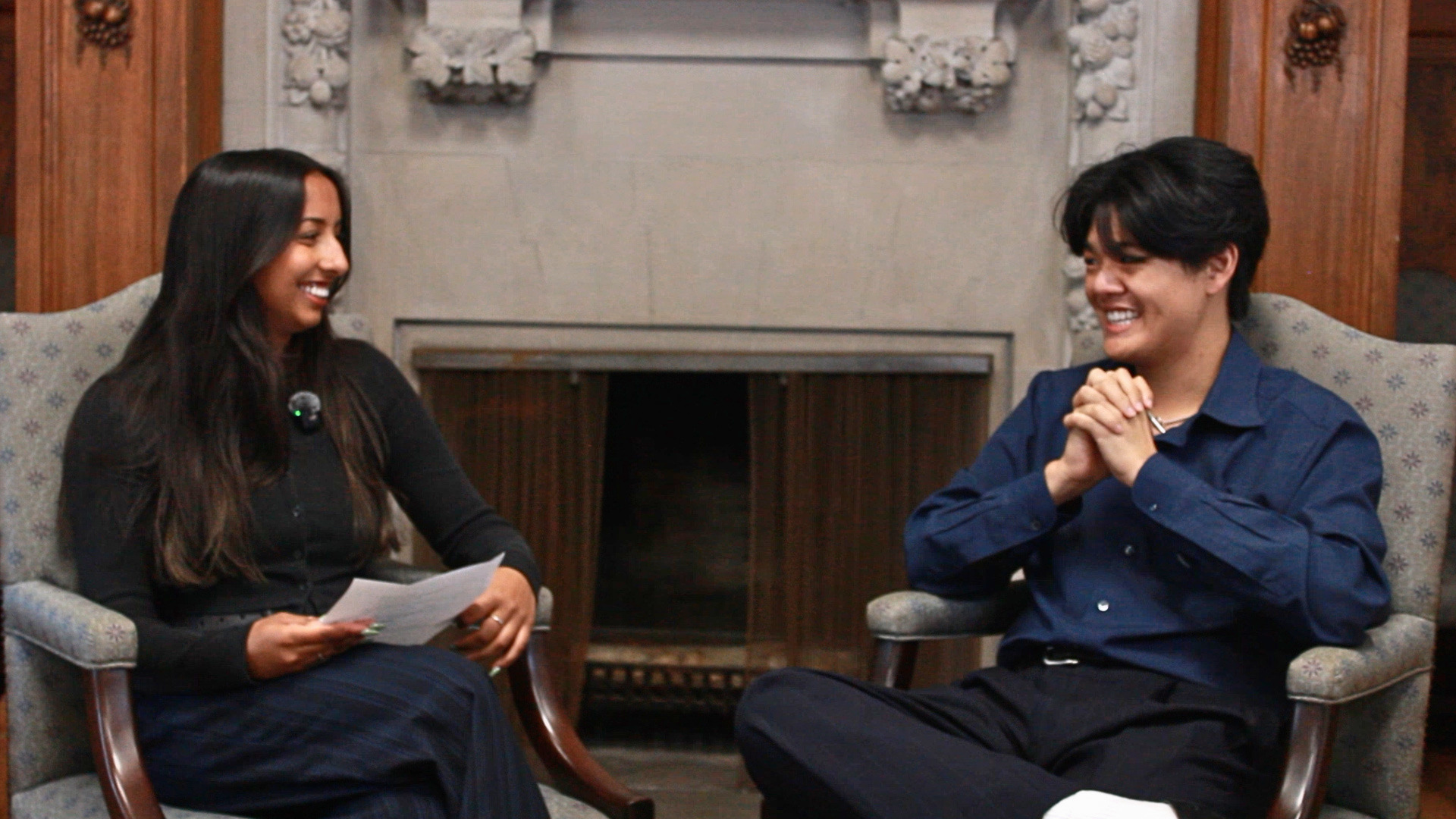
An Interview with Jeffrey Ma
“A lot of us at this law school have had access to tremendous privileges…[a]nd I feel like it is part of our obligation to do good, give back, and try to make the world a better place as best we can,” Jeffrey Ma said. That sense of obligation is what has guided Ma from a United Nations (UN) office in Geneva to a town hall in the Amazon, and now back to Canada, where he is beginning his articling term at the Migrant Workers Centre (MWC) in British Columbia.
Jeffrey Ma is a 2026 graduate of Henry N.R. Jackman Faculty of Law. During his time as a student at the Jackman Faculty of Law, his passion for human rights was evident through his extensive involvement with the International Human Rights Program (IHRP). From contributing to the IHRP Clinic in his 3L year, to working as an International Human Rights Program Fellow as a 2L, to leading the Sexual Orientation and Gender Identity Working Group, Ma has consistently translated his passion for human rights into practice. This past summer, Ma sat down with the IHRP to reflect on his time at the Jackman Faculty of Law and share his experiences working in the field of human rights.
Ma’s experience with international human rights work began during his 2L summer, when he interned as an IHRP Fellow with the Human Rights Liaison Unit (HRLU) of the United Nations High Commissioner for Refugees (UNHCR). Despite the UN being a massive institution, he was surprised to find that the day-to-day teams were relatively small, giving him the opportunity to take on significant hands-on responsibility across a variety of different projects. On a typical day, Ma supported the Human Rights Council unit, attended conferences and committee sessions, took meeting notes, and traversed the Palais des Nations.
Ma recalled one particularly memorable project in which he supported the Assistant High Commissioner in drafting a speech for the commemoration of Nelson Mandela’s birthday. For Ma, the experience was notable not only because of the subject matter, but also because of the responsibility and challenge of being entrusted with writing compelling remarks for a senior official within such a prominent international institution.
At the same time, it reinforced for him the importance of maintaining a critical perspective. “There is an important role for international institutions like the UN,” he reflected, “but it’s also important to be critical of the way that they operate.” Having to write from the perspective of someone so deeply situated within the institution challenged him intellectually in a way he had not expected, as he had to adopt a worldview that was not entirely his own. It is evident that Ma’s practical learning experiences have shaped his ability to approach human rights work with both a critical perspective and a commitment to principled advocacy.
As a student in the IHRP clinic in his 3L year, Ma was struck by how direct, meaningful, and hands-on the work was. His main project focused on developing a transnational legal strategy to seek accountability for human rights violations committed by a Canadian corporation in the Brazilian Amazon. The work included a site visit to Amazonas, Brazil, where he worked alongside several talented partner institutions in both Brazil and the United States. Reflecting on the collaboration, Ma noted, “It was an invaluable experience to work with a transnational team of really passionate people,” whose experience helped ground him when the scale of the work felt overwhelming.
Above all, he recalled being happily surprised by the amount of time students had to speak with, and work directly with, affected community members, including travelling to a town hall to listen to the concerns of one of the affected communities. This experience underscored the importance of building relationships with communities and understanding their perspectives in order to develop work that best reflects the realities of those being represented.
These opportunities ultimately helped solidify Ma’s interest in pursuing human rights work as a career. As he explained, these experiences showed him that this type of work was “not only possible,” but exactly what he hoped to pursue in the long term.
Now, Ma is continuing his commitment to human rights work closer to home as he begins his articling term at the MWC in Vancouver. The MWC is a non-profit organization whose mission is to help migrant workers understand and protect their rights—particularly when workers have legal problems with their immigration status or employment. When asked about his decision to pursue public interest work in Canada, he explained, “I felt like there would be some more meaningful public interest opportunities where I could give back to my own community that has given me so much growing up.” Ma expressed gratitude for the breadth of opportunities to work in the human rights field that the IHRP provided, which ultimately helped him gain a clearer sense of professional direction. In this way, he describes the IHRP as having played a very important role in shaping the next steps of his legal journey.
Jeffrey Ma’s academic and professional path offers just one example of how students can begin building meaningful careers in human rights work. His advice to students interested in this area is straightforward: reach out to organizations, lawyers, and programs such as the IHRP early on, even when doing so feels daunting. After all, the opportunities are there—students simply need to take the time to explore them.
When asked about how the IHRP shaped his legal career path, Ma was unequivocal: “The IHRP clinic was a truly formative experience, and I recommend that any student who might even consider being interested in human rights tries to sign up for it.”