My Summer at the IBA
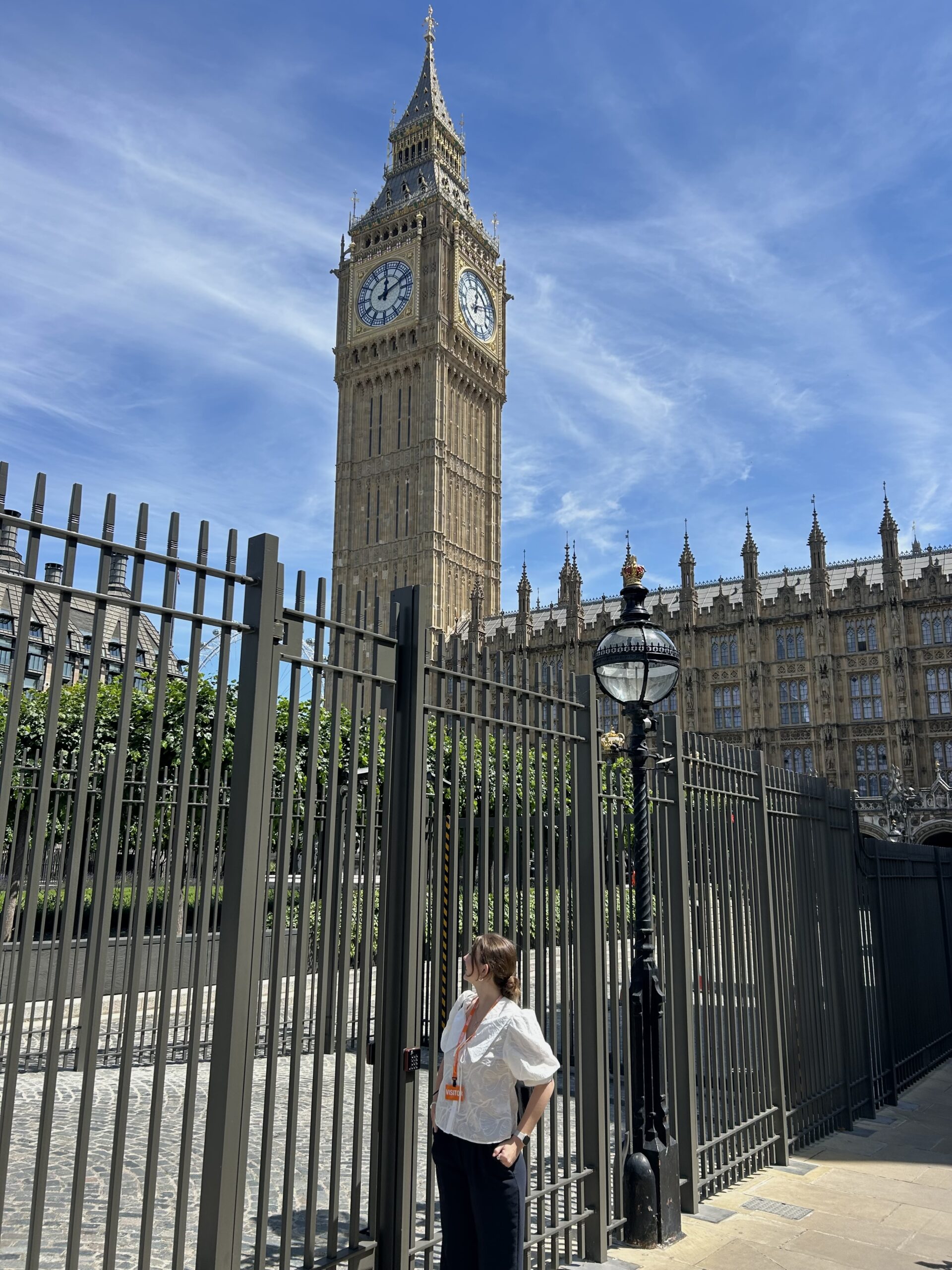
It was a once-in-a-lifetime experience watching England beat Norway in the World Cup semi-final, then hopping on the Jubilee line the next morning to go to Westminster Palace for an International Bar Association (IBA) event and hear Members of Parliament hum the tune of “Hey Jude” through Parliament corridors. With the support of the International Human Rights Program Fellowship, I spent this past summer in London, England, with the IBA. I interned with the Legal Policy Research Unit (LPRU), addressing the impact of artificial intelligence, gender disparity, climate change, and corruption on the global legal profession. Spending the summer at the IBA was a tremendous experience. It allowed me to work on a broad range of legal issues, learn alongside interns from around the world, and gain exposure to legal perspectives outside North America.
The IBA is an international membership organization founded in 1947 for lawyers, bar associations, and law societies. The IBA offers a plethora of resources to the international legal community, including conferences, webinars, resources, and information on how to promote the rule of law. The two main divisions of the IBA consist of the Legal Practice Division, which promotes the exchange of best practices and information on legal practice, and the Public and Professional Interest Division, which includes projects, activities, committees, and other entities. The LPRU, a separate team of project lawyers, is dedicated to conducting research, developing initiatives, and implementing strategies that positively impact the global legal profession.
Over the summer, I contributed significantly to the LPRU’s Raising the Bar: Women in Law project. Launched in 2021, the research project spans two phases examining women’s representation and experiences across the legal profession. The first phase examined women’s experiences in sixteen jurisdictions through country-specific reports, while the second phase takes a broader look at how law firms, individuals, bar associations, and the judiciary can address persistent gender disparities in the profession.
One of the most rewarding parts of my internship was contributing to the publication of the Canada Results Report as part of the Raising the Bar project. Given my familiarity with the Canadian legal system, I edited and contributed to the “Background on the Canadian Legal System” section. I revised sections and research on the composition of the Canadian judiciary, the role of the Canadian Charter of Rights and Freedoms, and Indigenous legal systems. It was particularly meaningful to contribute my knowledge of the Canadian legal landscape to an international research project and to see my efforts reflected in the final publication.
My research on gender also extended beyond Raising the Bar. I prepared a ten-page report alongside a co-intern on the implementation of the European Union (EU) Women on Boards Directive ahead of the June 2026 transposition deadline, examining how Member States in the EU had incorporated the Directive into their national legal frameworks. I also researched the soft law approaches taken by global jurisdictions with particularly high levels of gender equality, including Iceland and Namibia. Further, I was lucky enough to engage with gender-related legal issues outside of the IBA’s office. I attended parliamentary events on drug-facilitated sexual assault and conflict-related sexual violence, and was able to assist with preparation by drafting briefing notes for speakers in advance of the discussion.
My interest in gender equality precipitated my exploration of the impact of artificial intelligence on the proliferation of gender-based violence. For my final assignment with the IBA, I researched the legislative mechanisms deployed by the United States, Canada, and the United Kingdom in addressing non-consensual sexually explicit AI-generated media. My article, “Non-Consensual Sexually Explicit Deepfakes and the Law: Criminal and Platform Liability Across Three Jurisdictions,” is soon to be published in the IBA’s Intern Newsletter. I also had the opportunity to present my research to lawyers, legal professionals, and IBA staff, which sparked a discussion on the relationship between AI-generated sexual violence, platform responsibility, and freedom of expression.
On occasion, I was given the opportunity to work on assignments outside of the LPRU. At the beginning of my internship, I assisted the IBA’s Human Rights Institute (IBAHRI) with drafting an amicus curiae brief for the Supreme Court of Cambodia. An amicus curiae brief is a submission by an expert organization that is not a party to a case, with the aim of assisting the court in making its decision. As a leading human rights institution, IBAHRI offered their insight to the Supreme Court of Cambodia on the country’s international human rights obligations to protect media freedom. The case involved two journalists who had been arrested and sentenced to fourteen years in prison for taking photographs of a military site near the Thai-Cambodian border. Although the appeal was denied, contributing to the country’s crackdown on press freedom, I continued to assist the human rights lawyers with press briefs condemning the Court’s decision.
Beyond the workplace, I had an incredible three months in London. I immersed myself in the British culture of staying up late in a pub to watch Jude Bellingham and the rest of the England team tear their way through the World Cup. I travelled throughout the country; I visited Brighton Beach and ate fish and chips on a pier looking out at the English Channel; I spent a weekend in the Cotswolds and waded through fields of long grass while evading herds of sheep.
As a theatre fan, I made sure to get cheap tickets to West End shows spanning Agatha Christie legal dramas to the bright and fantastical Hercules. My IBA Intern Cohort was another highlight of the summer; I spent every day with nine other law students from France, the United States, Italy, Colombia, and India, who all brought different perspectives and ideas to the intern table. As a group, we toured the Royal Courts of Justice and walked through the same halls as the infamous Lord Denning. We went to pub trivia, combining our global and legal knowledge to come short in second place.
Looking back, my summer at the IBA gave me much more than an opportunity to research international legal issues. I saw how lawyers from different jurisdictions approach shared challenges, explored areas of law I care deeply about, and built friendships with people I otherwise never would have met. I left London with a broader understanding of what a career in international law can look like—and plenty of memories from a summer spent across the pond.