Embracing land-based learning on the Rama Reserve
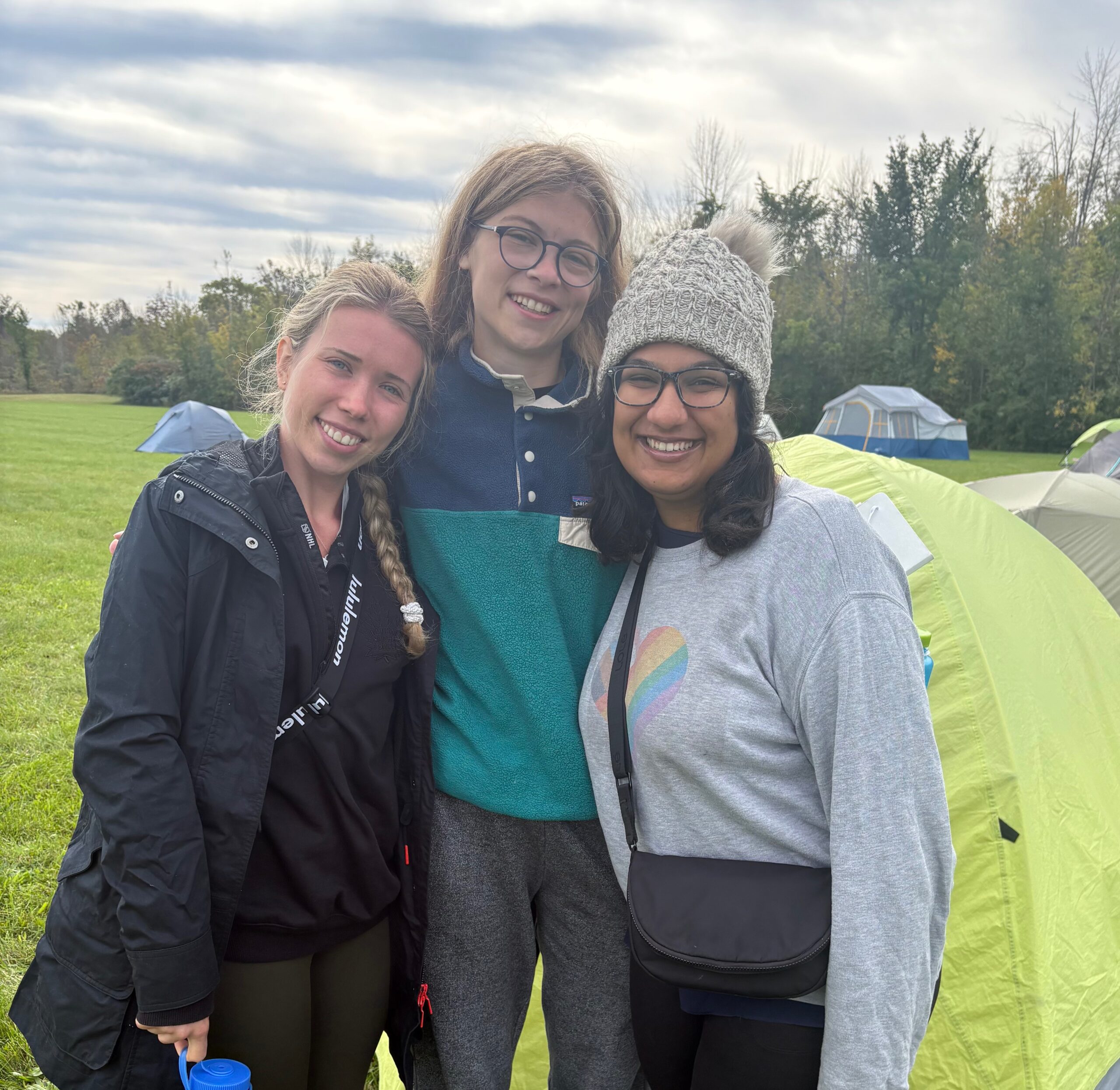
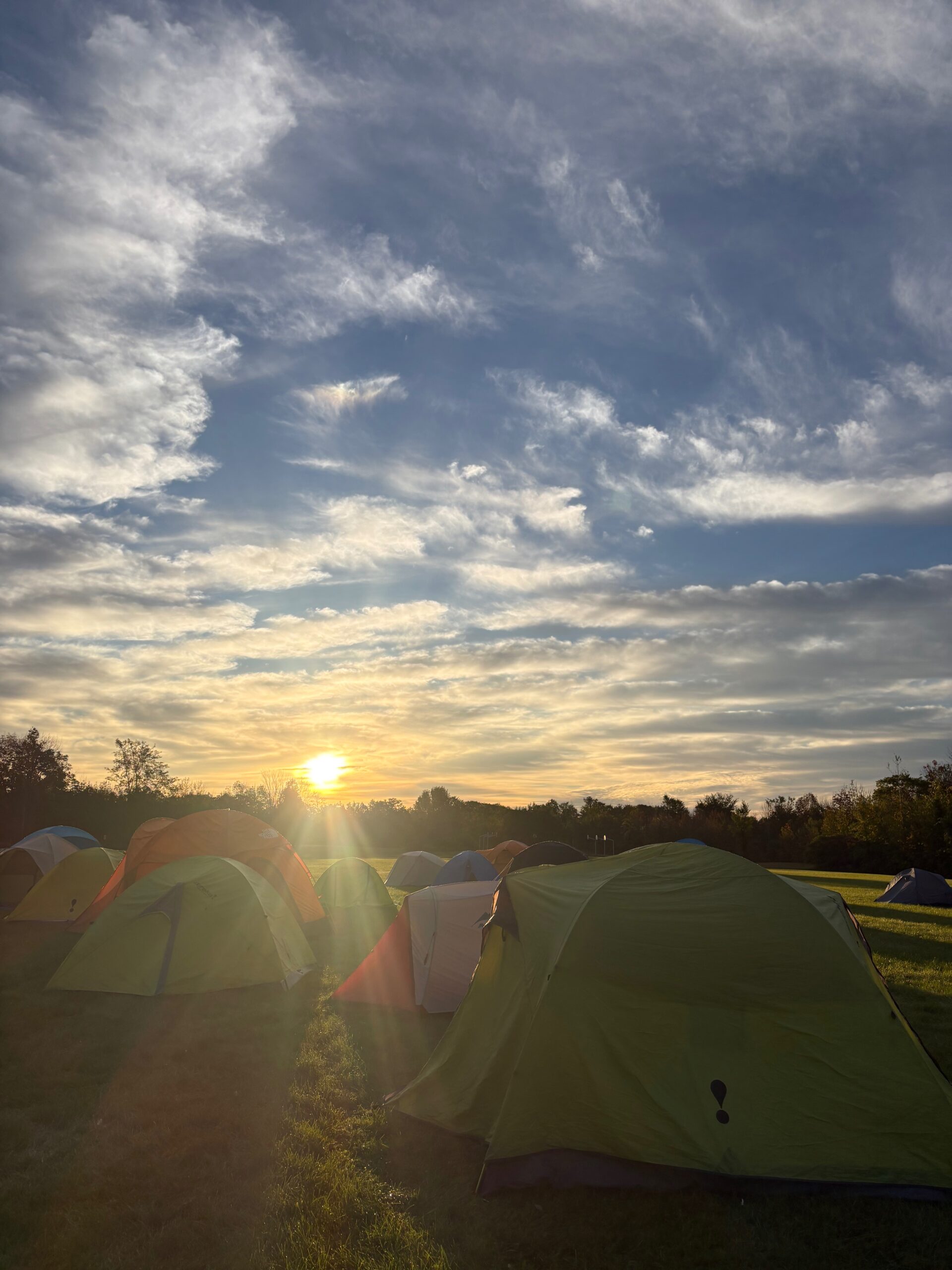
From September 17th to 20th, Jackman students had the opportunity to join law students from across the country to participate in Anishnaabe Law Camp on the Rama Reserve.
When we first arrived at camp, Jeff Hewitt, Rama in-house legal counsel, told us not to take any notes throughout the weekend. While this caught many of us law students off guard, used to scribbling down everything we can, it set the tone for a weekend of intentionality and reflection. We became comfortable with the fact that we were not going to memorize each of the teachings but would remember and carry forward what was meant for us.
Chief Ted Williams of Rama First Nation welcomed us to the land. He spoke about his journey to leadership with his grandson in his arms. In fact, throughout the weekend, children, who we learned are gifts from the Creator, were involved in and often at the centre of everything that we did. As Professor John Borrows often emphasized, in Anishnaabe language, “lawing” is a verb. Each of us, particularly as future legal professionals, has a responsibility to utilize, embody, create, and share law in a way that leaves this world better than we inherited it—for the children we encountered at camp and for all future generations.
That night, as we settled down around the ceremonial fire for teachings with James Simcoe, we looked up at the crisp, crescent moon surrounded by shining stars and felt a part of something so much bigger than ourselves. We realized that we were a small part of the more than natural world, and truly internalized the grandfather and grandmother teaching of humility.
On Friday morning, we participated in a sunrise ceremony that anchored us in the principle of gratitude. We each took tobacco in our left hand and participated in a smudge, grounding us in the spirit and our own roots. We gave thanks for everything we stand on the shoulders of—the more than natural world, the animals, the Indigenous communities who have cared for this land for centuries, and our own ancestors.
We were each handed a strawberry, or an ode’imin, literally translating to a heart berry. Evelyn Ball and Samantha Craig explained that the red body of a strawberry held great sweetness, and its green stem held sour healing properties. Perhaps just as a strawberry can simultaneously hold both sweet and sour, we have the ability to hold our privilege as law students with the responsibility to recognize and break down the colonial systems that surround us.
Professors John and Lindsay Borrows then provided us with a framework for understanding many of the teachings we were taking in. They spoke about the sources of Anishnaabe law, highlighting our ability to reason by analogy and understand law by watching the natural world. For example, the formation of geese as they migrate teaches us the basis for a legal principle of leadership. There is not a single goose that stays at the front of the flock the entire flight. Instead, they rotate, each leading for a portion of the time, depending on their capacity and specific knowledge. True leaders do not stay at the front the whole time, but rather share their expertise when needed and know when to take a step back.
We then had the opportunity to hear from Chief Lady Bird about her breathtaking artwork infused with teachings and Creation stories that was displayed throughout Couchiching Hall. She spoke about how carrying and birthing her son inspired and shaped her paintings. This artwork was a beautiful example of how creativity, stories, and humanity could find their way into urban spaces.
We had a chance to participate in interactive activities that allowed us to appreciate the Anishnaabe medicinal practices. While we may not have been the fastest at it, we practiced techniques for birch scraping to reveal the layer of the tree with healing properties. We also learned and tested our tongue in the Anishnaabemowin language. In Anishnaabe tradition, so much of who we are is tied to where we come from. We got to try introducing ourselves in relation to our hometowns and the groups we belong to.
That evening, we sat around the campfire listening to songs and stories from Professors John and Lindsay Borrows. We heard the Baby Bear Story—where Nick, as an ogimma who was trusted and counted on by the community, brought everyone together to utilize their own unique knowledge, skills, and resources to pursue the best interests of the baby bear. As Lindsay Borrows put it, we cannot all speak at the same time, but we can all sing at the same time, highlighting the great power in many diverse voices coming together in their own unique pitch and rhythm to create beauty.
On Saturday, we had the privilege of hearing from Sage Hartmann, a member of the community and a recent Federal Court Clerk, who spoke of her experiences clerking generally and, more specifically, her experiences working on cases pertaining to Indigenous issues and Aboriginal rights. Her presentation offered a perspective on engaging with Indigenous legal issues from within the Canadian legal system.
Her presentation was followed, however, by a different perspective on law and governance, this time grounded in Anishinaabe legal traditions. Elder Mark Douglas shared a story about how the community had responded to youth who had been causing harm to others to illustrate deliberative law-making processes that are part of Anishinaabe legal traditions. Rather than approaching the problem through an adversarial process, in which two opposing sides present their positions before a decision-maker, Mark described a process in which ideas emerged from the collective, as perspectives from all seven corners, the seven clans, were brought to the table.
In speaking to us, he walked to different corners of the room as he explained what different clans had to say about the issue. The movement was non-linear, much like the process of deliberation itself, as ideas flowed between people rather than travelling in a single direction from an authoritative decision-maker to everyone else. This embodiment of deliberate law demonstrated to us what it means to engage in law-ing as a verb.
We continued to see law in action when we travelled down the road to the Rama Community Farm, where manager Kailey LeDrew shared insights into their practice of “no spray,” meaning that no pesticides, herbicides, or other chemicals are used on their farm produce, ensuring the health and safety of the farm, community members, and the nearby waterways. We then got our hands dirty, literally, as we trekked out to the fields where we picked beans and weeded.
The Rama community farm—in addition to the delicious produce some of us brought to take home—also provided a way of seeing how Indigenous and Western ways of knowing can exist in relationship. During our visit, we were told how colonial farming practices were imposed upon Indigenous peoples as part of colonization. Despite this, Indigenous communities like Rama developed proficiency in agriculture and produced high yields. However, rather than simply adopting Western agricultural methods as they were imposed, the Rama community has adapted its practices in a way that reflects humility and deference to the natural world, allowing the land to do what it does best. Moreover, in order for the farm to be successful in supporting the community, these different approaches to agriculture did not have to displace one another. In fact, the community could inherit something shaped by colonialism without simply reproducing it, adapting and cultivating something that feeds—both literally and metaphorically—the community. The result is not the complete rejection of one approach in favour of another, but the coexistence of different ways of understanding and relating to the land, and by way of analogy, the law.
In keeping with this theme of the natural world and our relations to it as forms of teaching, upon arriving back at camp, we heard from Dr. Leora Gansworth. She told us about eels, an animal that has cultural and medical significance to Indigenous peoples in Ontario, as for many years, they would migrate to freshwater, inhabiting Lake Ontario, the Ottawa River, and the upper St. Lawrence River watershed, before returning to the Sargasso Sea to spawn. However, due to hydroelectric dams, biodiversity loss, overfishing, and water pollution, eels are rarely seen in these waters and are an endangered species. What stood out to us most in Dr. Gansworth’s presentation was not just how cool eels are (though they are, trust us), but how little she knows about them, their mating rituals, and even some of their migration patterns; she does not feel the need to know about these things in order to actively work to conserve the species. In the same way, we or anyone, for that matter, do need to know everything about any community of beings in order to recognize the inherent importance of cultural, legal, and linguistic revitalization.
The day ended with one of the most meaningful experiences at Law Camp: a sweat lodge ceremony. A sweat lodge is a traditional Indigenous ceremony that takes place inside a small, enclosed structure, where heated stones are brought into the lodge and water is poured over them to create steam and heat. The ceremony is traditionally understood as a process of cleansing and renewal, and it can involve prayer, reflection, teachings, and connection with the land, community, and spirit. While the specific practices and teachings associated with a sweat lodge vary between Nations and communities, the ceremony is a sacred practice.
While we, along with others due to capacity and personal preference, did not enter the sweat lodge, everyone had the opportunity to participate in the preparations and engage with the teachings shared beforehand. We heard about the personal experiences of participating in sweat from a community member, while some of us gathered and prepared cedar, helped clean out the lodge, and supported those going into the sweat. It was a really beautiful way to spend our last night on the trip—coming together in ceremony as we watched the sun set over Lake Couchiching.
After our last night of camp—and it was a chilly one (!)—we got back on the bus to return to Jackman Law. However, the bus was noticeably quieter than it was on the drive up to Rama First Nation. While this could have been due to lack of sleep or exhaustion from lesson-filled days, we think it was, in part, because there was much to reflect on. Hearing knowledge keepers, Elders, and community members share their experiences, stories, and ways of life really helped give us perspective, not only on the diversity of legal traditions within what we now call Canada, but on the ways in which we can learn from each other, from the natural world, and from observation of our surroundings—about the law and about ourselves.
We want to say migwech, thank you, to everyone who made this trip possible, including Professor John Borrows and Andrea Johns, and, most importantly, the Chippewas of Rama First Nation in Rama, Ontario.
As we continue to navigate our journeys in law school and life, we will keep with us the learnings of this weekend. We will continually be reminded of the collective obligation we hold toward all our relations. We will be forever grateful to have had this opportunity.