A reflection on the case, oral arguments, and judges’ comments
On October 1st, the Moot Court Room was filled to the brim, abuzz with excitement for this year’s Grand Moot. The topic to be argued, created by Moot Court Committee Co-Chief Justices Romina Hajizadeh and Yuha Khan, was titled “Right to Water? Balancing Charter Rights with Legislative Deference.”
At issue was section 5 of the Enabling AI Sovereignty and Economic Development Act. Aimed at stimulating economic growth by streamlining the development of AI data centres, this provision allowed “any AI Data Centre that does not consume more than 3.5 million litres of water per day” to be exempt from environmental assessment or permits.
The case centred on an unemployed single father named Roman Khan (a clever portmanteau of the Co-Chief Justices’ names). Mr. Khan lived in Jackmanville, a remote town facing regular water outages as a result of a nearby data centre’s unregulated consumption of the town’s water supply. This prevented him from fulfilling essential needs, including feeding his six-month-old child who was reliant on formula.
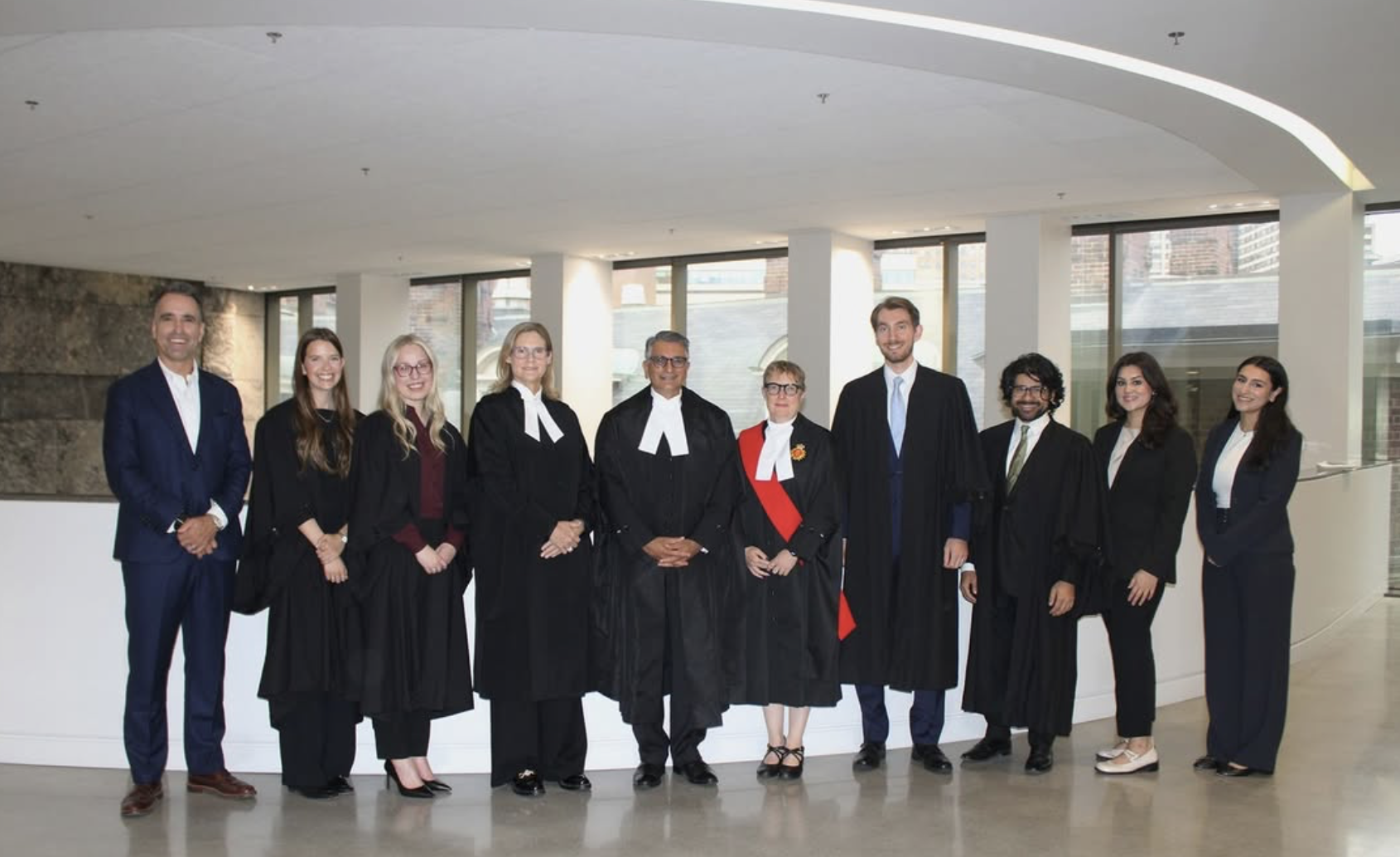
This year’s mooters were Evan Tanovich and Aaditya Juvekar for the appellant, and Rory Banfalvi and Madeline Ritter for the respondent.
For the esteemed judges’ panel, we had the privilege of welcoming The Honourable Justice Breese Davies from the Ontario Superior Court of Justice, The Honourable Associate Chief Justice Michal Fairburn from the Ontario Court of Appeal, and The Honourable Justice Mahmud Jamal from the Supreme Court of Canada.
The appellants and respondents argued on either side of the issue of whether section 5 of the Act was unconstitutional. The appellants’ position was that the Act violated section 7 (the right to life, liberty, and the security of the person) and 15 (the right to equality) of the Charter. They also argued that neither of these violations was justified under section 1. The respondents argued the opposite.
Tanovich covered the first of the appellant’s three reasons: violation of section 7. He asserted the appellant was not making a positive rights case because by enacting the Act, the government had undertaken to subvert environmental protections, which led to the water crisis affecting Mr. Khan. Tanovich, facing tough questions from the judges about the role of the democratic process in alleviating these issues, argued that the courts still have an important role to play. He argued that a government act incentivized private companies to operate in such a way as to bring about the crisis, which put Mr. Khan’s life and security of the person in jeopardy.
Juvekar covered the violation of section 15, submitting parental status as a new analogous ground for equality protection. When asked by Justice Jamal where the limits of this designation lie, Juvekar clarified that based on provincial and federal laws delineating legal dependence, this newly constructed immutable status covers parents of children aged 0-16. In satisfying Justice Davies that parental status exacerbated the harm Mr. Khan faced under the legislation, Juvekar noted that caring for his children prevented him from seeking employment. In response to Justice Fairburn’s concern about the public policy implications of framing parenthood as a basis for discrimination, Juvekar noted that though parenthood may also be a source of pride and joy, much like sexual orientation, it can simultaneously lead to marginalization.
The appellants made a compelling case for Mr. Khan’s hardships, but the respondents followed up with a hard look at the limits of the law.
Banfalvi rebutted the section 7 claim. She asserted that a positive rights claim was being made, because although there was an undertaking by the government, there is no constitutional right to environmental protection. Though Justice Jamal questioned the utility of making this positive/negative rights distinction, Banfalvi added that there is also no causal connection between the government action and the harm experienced by the appellant because the data centre was built by a private third party. Responding to Justice Davies, Banfalvi rebutted the appellant’s claim that the Act was an incentive, asserting a lack of regulation doesn’t make companies immune from being found privately liable for environmental harm.
Ritter addressed the section 15 violation. Responding to Justices Fairburn and Jamal, she noted that while historical discrimination in employment and housing can signal that parents face discrimination, it doesn’t mean parenthood warrants constitutional protection. She argued the disadvantage arose from the financial burden of parental status, and that wealth is not an immutable status. Ritter framed the harmful effects of section 5 of the Act as a function of Mr. Khan’s poverty rather than his parenthood. Justice Fairburn posed a tricky challenge, asking whether it was the care obligation to Mr. Khan’s infant preventing him from working that gave rise to the financial hardship. Ritter deftly handled the response, remaining empathetic to the situation while pointing out that Mr. Khan’s poverty was instead owing to the widespread economic crisis in the region that the Act sought to alleviate.
Justice Jamal remarked on the substantial challenge the mooters faced, saying the appellants had the facts on their side, while the respondents had the law on their side. While the appellants could appeal to empathy, the respondents asked us to consider the practical realities of governance in the face of complex economic problems.
Justice Fairburn complimented the factums, stressing the importance of a well-written argument. She was also impressed with the oral arguments and how skillfully the mooters signposted their arguments, addressing tough questions as they came and maintaining an impressive level of composure and confidence.
Justice Davies said that if she had counsel like the mooters in front of her every day, her job would be much easier.
The justices also acknowledged the whole team behind the event, from those who created the problem to the coaches and organizers. Everyone’s hard work contributed to the event’s success.
The attendees were also left wowed by the conduct of the mooters, excitedly discussing their own opinions on the challenge. As the justices stressed, all the mooters and everyone who worked behind the scenes to make the Grand Moot happen should be proud of their massive accomplishment.