








Mooters addressed an innovative problem exploring the relationship between a self-governing Indigenous Nation and Canadian Law
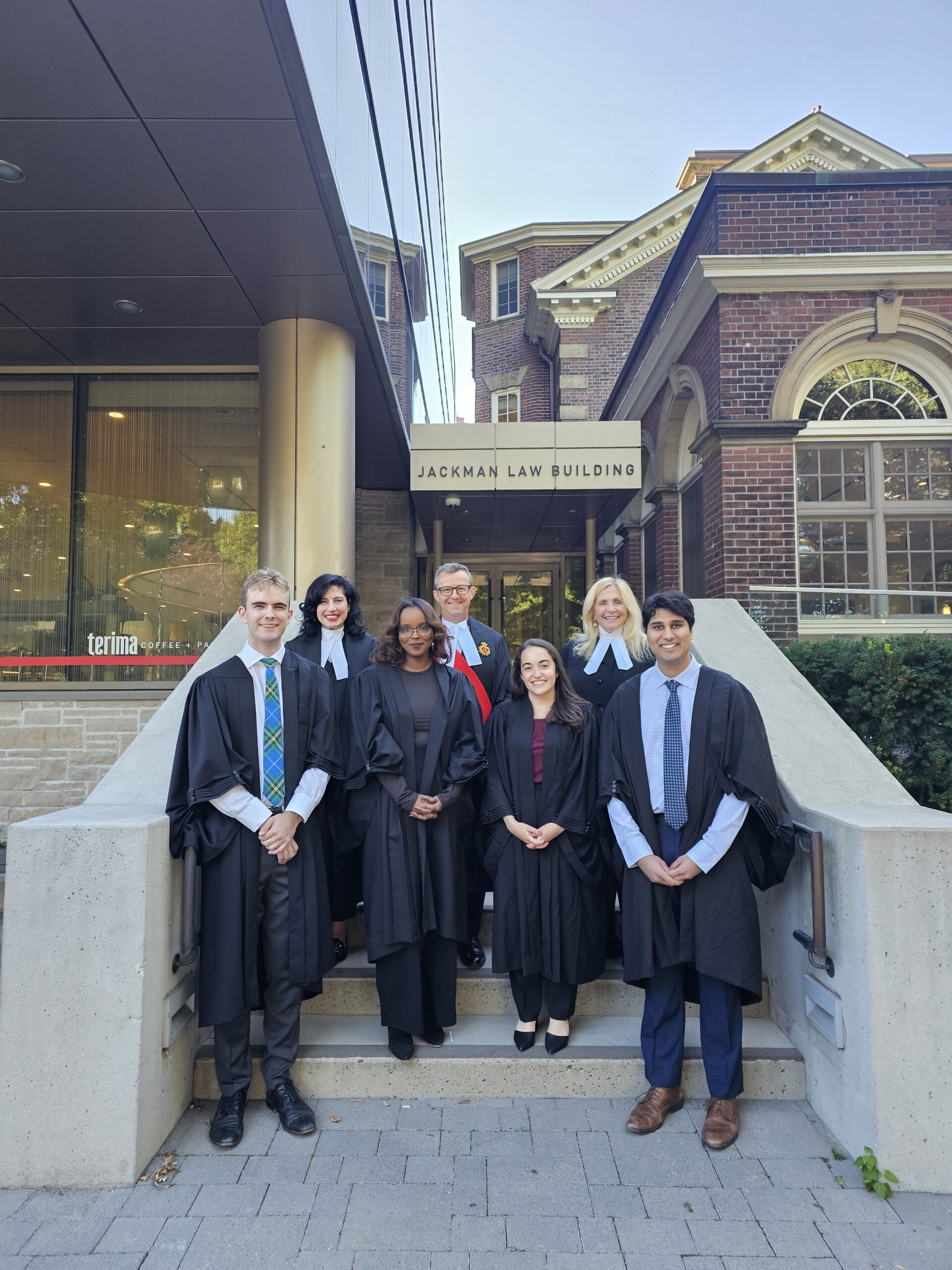
On September 29, 2025, the annual Grand Moot took place at U of T Law. The room was full of students, professors, and lawyers eager to see the four mooters take on a complex and challenging problem involving Charter applicability and double jeopardy in self-governing Indigenous communities.
This year’s Grand Mooters were Akash Jain (3L) and Sarah Zaitlin (3L) for the appellant and Ikran Jama (3L) and Matthew Farrell (3L) for the respondent. The distinguished panel hearing the appeal was composed of the Honourable Justice Sheilah Martin of the Supreme Court of Canada, the Honourable Justice Rénee Pomerance of the Ontario Court of Appeal, and the Honourable Justice Robert Centa of the Ontario Superior Court of Justice.
The moot problem, Kate Sheth v Mohawks of Kahnawà:ke, was written by Co-Chief Justices Navya Sheth (3L) and Kate Shackleton (3L), with the assistance of Bench Clerks and the inaugural team of Junior Bench Clerks.
The problem was set in the fictional country of Flavelle, where Kahnawà:ke is an Indigenous reserve in the province of Falconer. It is one of the eight communities that make up the Kanien’kehá:ka (Mohawk) Nation, which is one of the six nations of the Haudenosaunee Confederacy.
The Kanien’kehá:ka (Mohawk people) of Kahnawà:ke are governed by Haudenosaunee law. While Kahnawà:ke had no self-governance agreements with the country of Flavelle or with the province of Falconer, it had framework agreements with Falconer which enabled offenders of minor crimes to be referred to the Skén:nen Aonsón:ton. The Skén:nen Aonsón:ton is a restorative, peacemaking process whereby the community can “resolve conflict in a way that reflects their traditions and teachings.” In addition, the Kahnawà:ke Justice Act, implemented by the community decision-making process (“CDMP”), created the Court of Kahnawà:ke with “original general jurisdiction within the Territory in all civil, criminal, and penal matters.”
Kate Sheth, a non-Indigenous woman, was driving home from Kahnawà:ke under the influence when she veered off the road and damaged the Kahnawà:ke community garden. She was arrested outside the reserve, charged with impaired driving under the Criminal Code, and given a $1,000 fine and a one-year driving ban. Later, unaware of her section 11(h) Charter rights, Ms. Sheth voluntarily participated in the Skén:nen Aonsón:ton process. It resulted in a $500 fine and an obligation to spend four weekends learning about the community garden, as well as helping to replant it. Ms. Sheth was barred from the reserve until she completed the requirements.
After learning about her constitutional right to be protected from double punishment, Ms. Sheth decided to challenge the constitutionality of the punishment imposed through the Skén:nen Aonsón:ton process. Her appeal raised three issues: (1) whether the Charter applied to Kahnawà:ke, (2) if so, whether her conviction in the Kahnawà:ke Court and participation in Skén:nen Aonsón:ton process violated her section 11(h) Charter right to be free from double jeopardy, and (3) if yes, whether Kahnawà:ke would be shielded by section 25 of the Charter based on a right to self-government over criminal matters.
Speaking first for the appellant, Akash Jain argued that the Charter applies to Kahnawà:ke and that the breach of Ms. Sheth’s section 11(h) rights were not shielded by section 25 of the Charter. Jain argued that the Charter applies to Kahnawà:ke because it is a “government by nature,” based on its delegated authority from the federal government under the Indian Act. In response to a question by Justice Pomerance, Jain asserted that since there is no constitutionally protected rights regime in Kahnawà:ke, “it’s especially important that we implement the Charter in this case”. Next, he argued that the Charter should apply because the text of section 32 does not explicitly exclude its application. In response to a question from Justice Martin about reconciliation, Jain asserted that applying the Charter would affirm the legitimacy of the Kahnawà:ke governance structure and that “like all governments, they should be subject to the Charter.”
Sarah Zaitlin argued Ms. Sheth’s section 11(h) rights were infringed because the Skén:nen Aonsón:ton is criminal in nature and imposed a criminal punishment. She received an immediate question from Justice Centa asking how Ms. Sheth could now assert a Charter right, given her voluntary participation in the Skén:nen Aonsón:ton process. Zaitlin responded
that Ms. Sheth could not have waived her section 11(h) rights since she did not know they existed in the first place. Later, Justice Martin asked whether the restorative nature of the Skén:nen Aonsón:ton meant it was outside of the punishment model. Zaitlin responded that the Skén:nen Aonsón:ton had both restorative and punitive elements, which should be considered together, given the Supreme Court’s articulation in R v KRJ that punishment must be defined liberally. Zaitlin went on to say that the Skén:nen Aonsón:ton had all the hallmarks of a criminal proceeding even if it lacked the “window dressings” of Western criminal proceedings.
Turning to the respondents, Ikran Jama argued that section 32(1) does not apply to Kahnawà:ke and that, even if the Charter applies, section 25 would shield any infringement. On the first issue, she asserted that there was no delegated authority. She argued that the Kahnawà:ke had always rejected the Indian Act’s legitimacy and that the lawmaking authority rested with the community and not with the band council. In responding to a question from Justice Martin, Jama said that while Kahnawà:ke is a government, “it is not the kind of government that was ever meant to be captured within the scope of section 32(1).” Jama further argued that there was an irreconcilable conflict between Ms. Sheth’s section 11(h) rights and Kahnawà:ke’s right to self-govern over criminal matters because Kahnawà:ke would always be prevented from exercising that right. Lastly, she asserted that imposing the Charter would undermine the principle of reconciliation and that the question was “whether we apply the Charter or respect Indigenous values, knowledges, and capabilities.”
Matthew Farrell finished the respondents’ submissions and argued that Ms. Sheth’s section 11(h) right was not infringed. He argued that because she was not charged with an offense, she was not punished, and even in the alternative, the punishments would not be duplicative. Farrell asserted that the voluntary nature of the Skén:nen Aonsón:ton was “categorically opposed to the coercive nature” of criminal law. Justice Centa asked how to reconcile there being criminal matters that are not criminal in nature to which Farrell responded that Kahnawà:ke had the right to “govern over criminal law, just in a fundamentally different way from Flavelle.” He went on to argue that restoration was the primary purpose of the sentence under the Skén:nen Aonsón:ton. Further, even if it were considered punitive, Ms. Sheth’s punishments would not be duplicative because the Criminal Code and the Skén:nen Aonsón:ton dealt with fundamentally different behaviours.
After a brief recess, the panel returned and gave the mooters glowing feedback. Justice Martin began by saying the problem was “unbelievably difficult,” and that she was impressed by the mooters’ sophisticated argumentation and understanding of the problem, and that she “loved” how all mooters responded to questions.
Justice Pomerance commented that the “written facta were absolutely tremendous” and that each mooter had “tremendous style,” “poise” and “mastery of the material.” Finally, Justice Centa remarked that the mooters performed “spectacularly” and there was “nothing more they could ask for.” He finished by addressing the 1Ls in the room, encouraging them to take the opportunity to reflect on the performance and have it inspire their own learning.
Afterwards there was a reception where the mooters, judges, and audience members mingled and celebrated another successful Grand Moot. As always, the Grand Moot programming is only possible due to the hard work of the mooters, the Moot Court Committee, the Bench Clerks and Junior Bench Clerks, the administration, coaches, and the support from its generous sponsors. It is a full community event that showcases some of the brightest talent U of T Law has to offer. We cannot wait to see what next year’s Grand Moot will bring!