








Unpacking the province’s funding overhaul and what it means for the future of legal education
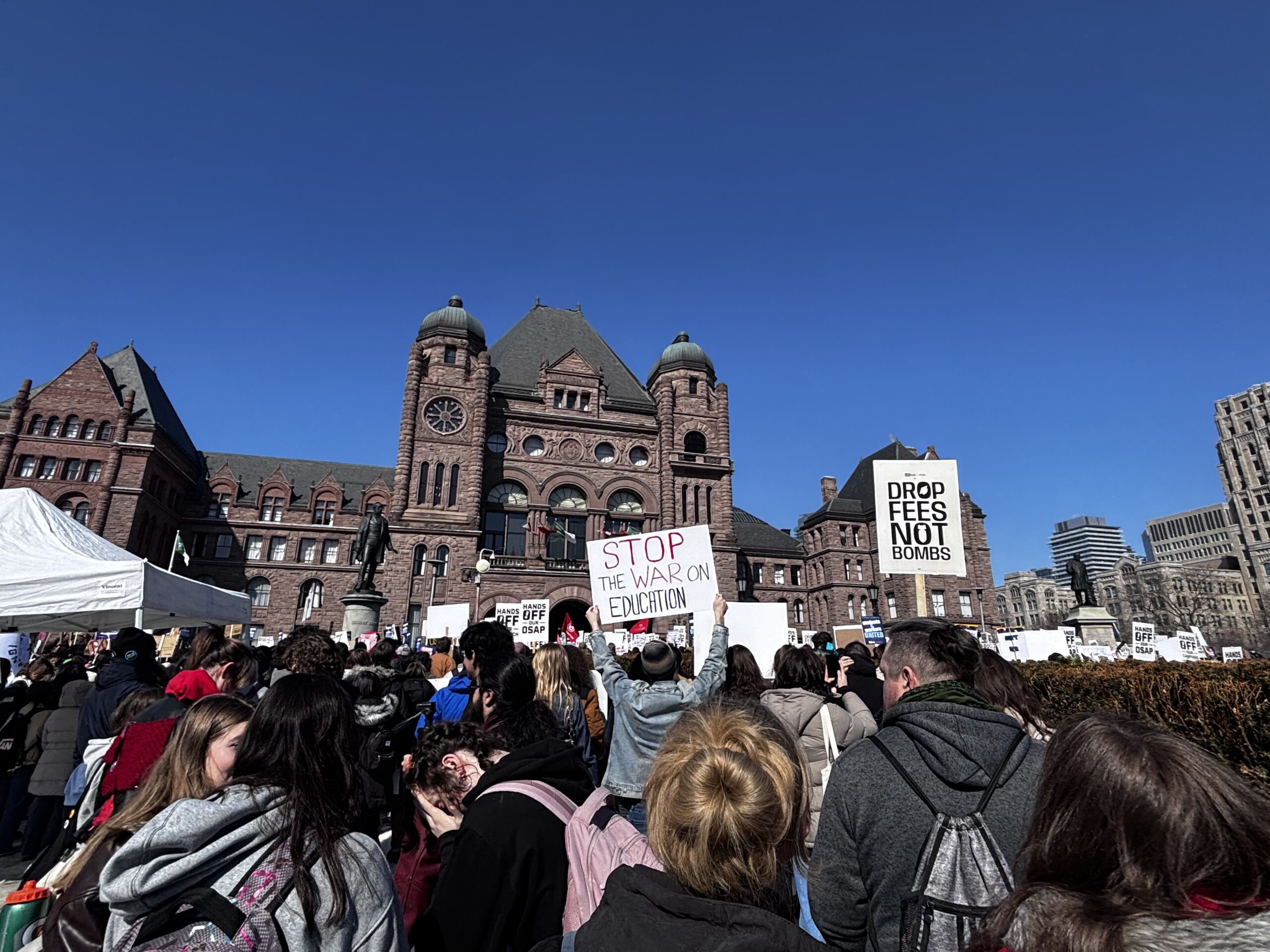
[Insert: Xu_From Grants to Debts: Ontario’s OSAP Overhaul_Photo 1_Caption: On March 4, students took to Queen’s Park to protest against recent OSAP cuts. Credit: Grace Xu]
On February 12, 2026, Ontario’s Minister of Colleges and Universities, Nolan Quinn, announced a sweeping overhaul of post-secondary funding: a $6.4 billion investment over four years, paired with structural changes to tuition and student aid. While the province has framed the announcement as a long-overdue response to financial strain in higher education, students across Ontario are raising concerns that the reforms will come at a significant cost.
At the heart of the controversy is a dramatic shift in the Ontario Student Assistance Program (OSAP). Beginning in the 2026–2027 academic year, the proportion of non-repayable grants available to students will drop sharply, from as much as 85 per cent of aid to a maximum of 25 per cent. The remaining 75 per cent will be delivered as loans. The province will also lift its years-long tuition freeze, allowing institutions to raise tuition by up to two per cent annually for three years.
The province has justified the reforms as necessary to stabilize Ontario’s post-secondary sector. Universities and colleges have faced mounting financial pressure in recent years, exacerbated by declining international student enrolment following federal caps and longstanding concerns about underfunding.
The new funding package promises 70,000 additional seats in high-demand programs, increased support for costly fields, and higher per-student funding. However, for many students, the benefits of institutional funding increases are overshadowed by the immediate impact on affordability.
Because OSAP is jointly funded by federal and provincial governments, these changes will primarily affect the provincial portion, roughly 40 per cent of total aid. Still, the impact may be significant. Estimates suggest that students receiving maximum assistance could see approximately $3,500 shift from grants to loans in the upcoming academic year.
Voices from the Frontlines
On March 4, hundreds of students gathered at Queen’s Park to protest the changes. Ultra Vires spoke with students from across Ontario, many of whom described the reforms as a step backward for accessibility.
Johan, a second-year business student at Seneca Polytechnic, emphasized the broader social implications. “Many students depend on this support just to access education,” he explained. “Investing in students isn’t a handout; it’s an investment in Ontario’s future workforce. This model can be sustainable: today’s taxpayers fund today’s students, and graduates contribute back into the system. Reducing support like this risks pushing us toward a US-style system of lifelong student debt. That’s a step in the wrong direction.”
Others highlighted the uneven impact across institutions, where the concerns are even more acute for students at private career colleges. Fin, a student at Toronto Film School, noted that grants were essential in making their education possible. “Removing grant eligibility for private-college students doesn’t just hurt me; it will make it nearly impossible for future students in similar financial situations to pursue the education they want.” This sentiment was echoed by artists and art students who see the cuts as a cultural affront. A father and actor at the rally, whose two children will be directly affected by these newly announced funding cuts, saw the move as a devaluation of the arts. “It’s an insult,” he said.
For prospective students like Milo, a Grade 12 student from Brampton hoping to study urban planning or economics, the changes are already shaping his future. “This makes post-secondary education harder to afford,” he said. “I believe education should be free. The government is completely out of touch with our realities.”
Perhaps most striking was the presence of students who will not be personally affected by the changes but attended in solidarity. Vic, a political science student at York University, was there to support classmates who rely on OSAP. “This is an attack on students,” Vic stated plainly. “They’re shifting the burden onto domestic students through tuition hikes and reduced grants. It’s an equity issue.”
Nathaniel, a fourth-year philosophy student at U of T, offered a philosophical perspective on the policy’s implications. “Wealthier students retain the freedom to study what they choose,” he observed. “Others will be pressured into ‘economically viable’ programs solely because of financial constraints. That’s not just unfair to individuals; it could oversaturate those industries and limit job opportunities. Education has value beyond job training—it prepares people for democracy, for cultural and intellectual life. That’s what’s being threatened here.”
The Law School Perspective
While the impact of OSAP changes will vary across disciplines, law students may face particular challenges. Legal education is already among the most expensive forms of post-secondary study in Canada. Tuition, living expenses, and licensing costs combine to create a substantial financial burden, often requiring students to rely heavily on a mix of OSAP funding, private lines of credit, and institutional aid.
For prospective law students like Santiago, a fourth-year student preparing to apply to law school, the shift from grants to loans is especially concerning. Coming from a lower-middle class background, he expects to depend on financial aid to pursue legal education. Increased reliance on loans, he said, may force students to work more during school and graduate with significantly higher debt.
“These changes will make continuing my education far more difficult,” Santiago explained. “Shifting aid from grants to loans means I’ll have to work more during school and carry heavier debt into my early career. It’s not just about arts students either. The government talks about ‘in-demand’ fields, but even students pursuing healthcare or STEM programs will face higher barriers and more debt under this system.”
The implications extend beyond individual finances. Higher debt loads may influence career decisions, potentially discouraging graduates from pursuing public interest law or lower-paying areas of practice. Over time, this could have broader consequences for access to justice and the diversity of the legal profession.
In response to the OSAP overhaul, SLS released a faculty-wide statement acknowledging the additional financial pressure the changes would place on students, particularly those concerned about accessibility to higher education. While the SLS committed to advocating with the administration, the statement distanced itself from the March 4 rally, clarifying it was “not associated with this rally or involved in its organization.”
Ultra Vires reached out to the Faculty’s Financial Aid office to understand how the school plans to respond to the recent changes. In their response, the office indicated that they were also “surprised” by the changes but remained committed to supporting students with demonstrated financial need. The office explained that OSAP funding is split between federal and provincial sources, and that most grants are treated as financial resources when assessing a student’s need. With the reduction in provincial grants, some students will appear to demonstrate greater financial need. The Faculty indicated it expects to address this gap through their internal bursary program and assistance with Professional Lines of Credit.
Crucially, the Financial Aid office highlighted the robustness of its internal resources. Their budget has grown from $5 million to an expected $6 million for the upcoming year, and over the past five years, their bursaries have covered 90 to 100 per cent of “unmet need” as defined by their policies. “With the additional donor support recently secured,” the office wrote, “we anticipate continuing to meet students’ demonstrated financial need at levels consistent with recent years.”
Looking at the Big Picture
At its core, the OSAP overhaul reflects a shift in how the province conceptualizes higher education funding.
Under a grant-heavy model, the cost of education is shared more broadly across society, with public funding reducing the burden on individual students. By contrast, a loan-heavy system places greater responsibility on students themselves, effectively treating education as a private investment rather than a public good.
This shift risks entrenching inequality, as students from lower-income backgrounds may be more debt-averse or less able to absorb financial risk. Supporters, however, may view it as a more sustainable model in the face of fiscal constraints.
For law students, and the legal profession more broadly, the stakes are particularly high. Access to legal education has long been tied to questions of representation, equity, and public service. Changes that affect who can afford to attend law school may ultimately shape who becomes a lawyer, and whose interests the legal system serves.
Looking Ahead
As details of the new OSAP framework continue to emerge, uncertainty remains about its full impact. What is clear, however, is that students will be navigating a more complex and potentially more burdensome financial landscape.
For now, student protests signal that the debate is far from settled. Whether the province’s investment in institutions will offset the increased costs borne by students remains to be seen.
In the meantime, for those considering legal education, the question is becoming increasingly difficult to ignore: not just whether to pursue a law degree, but at what cost—and for whom that cost will be too high.