








Wright was the first dean of the U of T’s professional law school
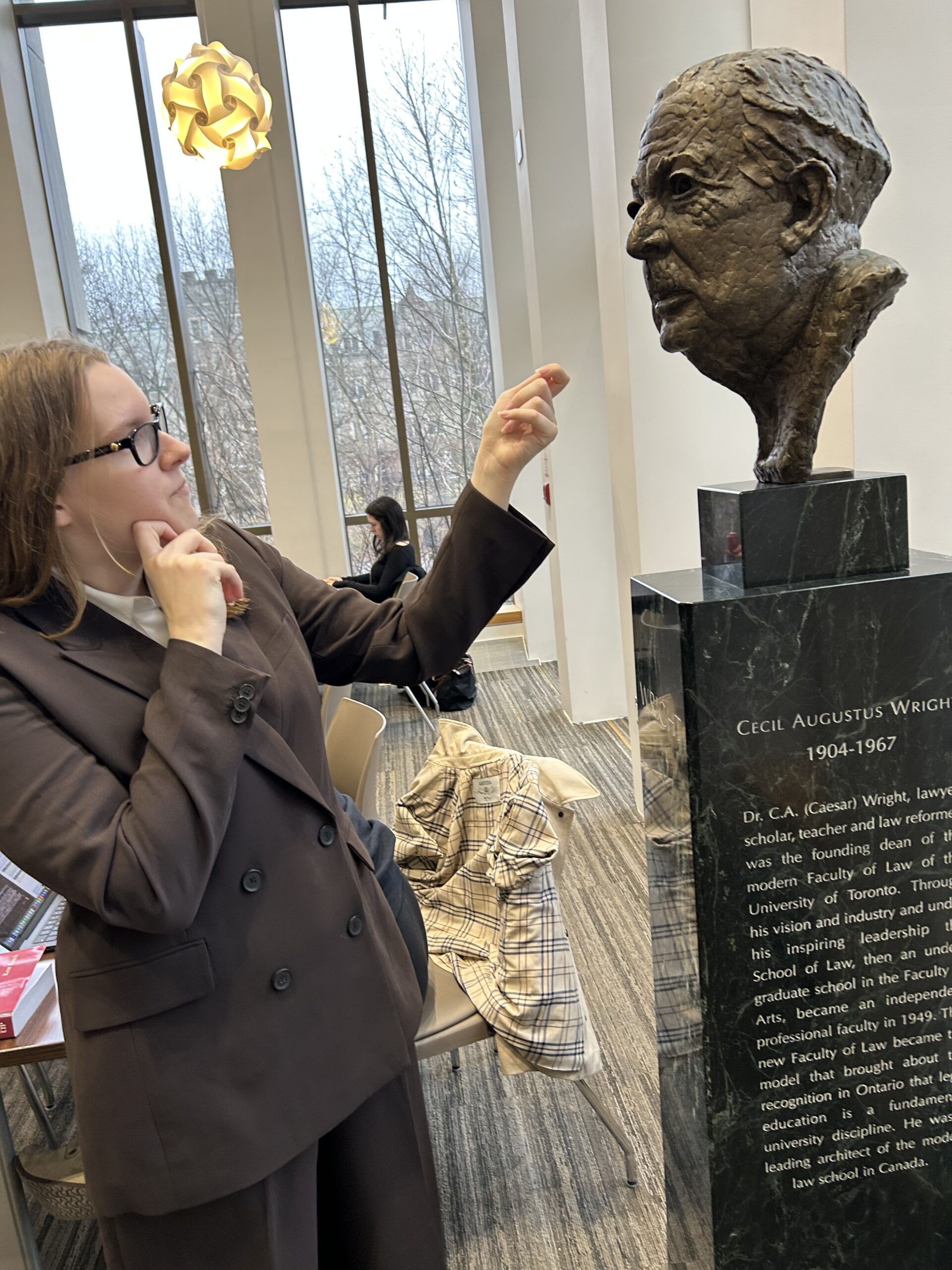
Bora Laskin gets all the fame, but there is another bust in the law school, that of Cecil Augustus “Ceasar” Wright, the co-founder of the modern incarnation of UofT’s law school. We talked to Ceasar to find his perspective on law, life, and living in the fishbowl.
Ultra Vires (UV): You’ve lived in the fishbowl for 10 years, what have you seen and what does it tell you about the state of legal education at UofT today?
Cecil Wright’s Head (CWH): Seeing students hard at work studying, and meeting in the study rooms is very encouraging. It tells me that the state of legal education has greatly improved compared to my day. When I was a student at Osgoode Hall, the casebook method of studying was only starting to gain prominence in Canada, and a large hindrance to it was the lack of time students were able to study due to their placements as articling clerks during most of the day. Instead, many courses still followed didactic and dictating lecture styles that I once referred to as “boring as they were unrealistic.”
I think building a culture and environment where students are able to devote significant time to study and thought about the law is essential to the modern law school I have created in Canada. It is also obvious that the casebook style of teaching greatly improved student interest in the material. I see students animatedly discussing cases with their friends, which was much rarer in my time as a student. Questioning and analyzing cases and legal principles is a necessary part of learning law, and seeing it every day would bring a smile to my face (if I could smile.)
UV: Do you like living in the fishbowl?
CLH: It’s rather chilly in winter.
UV: If you didn’t live in the fishbowl, where would you live?
CLH: I would live somewhere else in the library. I think that a robust library is key to this modern law school.
UV: Should UofT’s law school install more busts?
CLH: No. Bora and I are perfectly fine with the present number.
UV: Which law school classroom are you?
CLH: According to the quiz, I got mostly D’s and am P105
Now into more substantive questions:
UV: You experienced and pushed for changes in legal education from the LSO in your work leading the UofT law school. How was that and how do you feel about it today?
CLH: I think it was an essential change in how lawyers are trained and become a profession in Ontario. The Law Society of Upper Canada and Osgoode Hall were too narrow in directing legal education in a trade-like fashion towards the legal profession. In my view, law schools have to balance the competing aims of university scholarship in advancing knowledge, while still preparing lawyers for the necessities of their profession and the practical expertise required of being a practicing lawyer.
The changes in legal education allow students to engage in the scholarship of a university law school, while still building practical experience through articling and clinic placements. These placements do not take away from the core function of a university law school to provide education, but do provide students with a way to learn concrete practical skills that are harder to convey through the university law school format. I believe the University of Toronto law school has lived up to my vision of the university law school and how I tried to guide the law school during my time here as dean.
UV: Thoughts on the Cecil A Wright lecture?
CLH: While I am immovable and unfortunately could not attend, I believe it is an important subject to discuss. I am very passionate about the comparative study of the law, across jurisdictions. When I was young, Canadian legal study focused rather narrowly on English jurisprudence, with significantly less cross-cultural study of jurisdictions across the English-speaking world, such as the US or Australia. When I studied at Harvard, my eyes were opened to the field of comparative legal study, and I feel it is important to examine legal topics from other jurisdictions. Thus, I am very glad this tradition continues at the University of Toronto Faculty of Law.
UV: The LSO is again pondering changes to the legal curriculum, what are your opinions or reflections?
CLH: I believe legal training should instill the values of fact consciousness, the capacity to recognize the issue at hand, comprehensiveness in viewing problems, foresight, the lingual sophistication of avoiding being fooled by words and catch phrases in a legal problem, precision and persuasiveness in speech, and thoroughness, as I cited in my 1950 speech in the Canadian Bar Review. I believe that the LSO should consider these objectives in making their changes and evaluating how to further improve legal education in the province.
UV: Favourite area of law?
I dabble in every area of law, but I especially like torts.
UV: Tips for studying?
CLH: May I suggest…The Library?
UV: Why are you forgotten?
CLH: I think I am forgotten because I am in a spot few people look, unlike Bora’s head outside the library doors. Why don’t I get a water fountain? Additionally, I think that changing legal education is essential, but less flashy than being a supreme court justice.
UV: Last Words?
CLH: Modern fluorescent and LED lights really improve the amount of time students could spend studying, if only they stopped looking at their phones so much.
UV: Do you ever get a stiff neck?
CLH: Yes. It is the point of being a bust. If I didn’t have a stiff neck, I would be a bobblehead.